Call Us Free: 1-978-388-2585

Archive for April, 2010

In-ground pool decking options

No in-ground pool feature has  more of a dramatic affect on your backyard then the pool deck. It used to be that vinyl liner pools suffered from ugly white aluminum coping and lackluster pool decking.  Now we use special cantilever coping edges to provide seamless transitions into beautiful pool patios that really make the pool the backyard center piece it should be.

Lets face it, after you add the grill, patio furniture, and maybe a fire pit, you end up spending much more time out ‘by the pool’ then ‘in the pool’. This makes choosing the right pool deck  one of the most important decisions during the pool building process.

There are quite a few options available for pool decking, below are some of  the different decking options you have as well as approximate pricing for each.

Standard Brushed concrete appx. $6.50 sq/ft

Standard concrete offers a nice clean look  and is the least expensive option available. I will point out in this particular picture we are not seeing a cantilever edge, instead it is a concrete receptor coping. Cantilever edges that are seen in the remaining photos are available in standard concrete as well.

angle pool.JPG

Standard Brushed Concrete

Stamped concrete appx. $10 sq/ft

This pool features a textured grey stamped concrete with a cantilever edge. The concrete is colored and imprinted while it sets for a great custom look.

Stamped concrete pool deck

Stamped concrete with cantilever edge

Exposed aggregate appx. $10.50 sq/ft

Exposed aggregate is our most popular decking option. Utilizing natural river stone mixed into the concrete. Aggregate has many different colors to choose from as well.

exposed aggregate pool deck

exposed aggregate

Paver patio blocks appx. $14 sq/ft

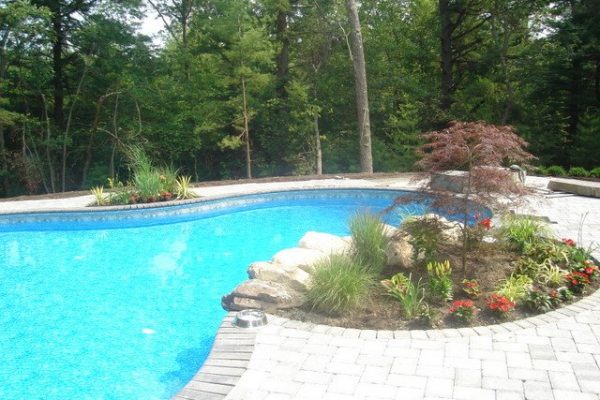
Paver patios are the most expensive decking option but also offers the most variety. Using custom stones you can create any feel you want with patio block decks and there are some great options for stone coping edges to create a great border around the pool.

paver patio pool deck

paver patio pool deck

We also now offer complete paver patio deck and retaining wall solutions for your entire backyard. For a list of our paver patio services head on over to our Patios and Retaining Walls page for more details

There are many variations on all decking options seen above and I encourage you to check out our pool galleries to view more pool decks and designs.  Also you can view more decks by our friends over at Triad Associates who install  our poured patio decks.

After the pool itself the pool deck is the most expensive part of the in-ground pool installation, and you really should take some time to decide exactly what option fits your needs, style, and budget.

If you have any questions or comments you can contact us here or leave a reply below, we would love to hear from you.

Read more

Variable speed pool pumps

When you want your pool to go green!

As the world goes green and the economy stays stagnate we are all looking for ways to be more energy efficient and save some money.

One common energy hog in the summer months is your swimming pool. If you have owned a pool for even one season you noticed the jump in your electric bill once that pool was opened. I want to dedicate a series of blog posts to cover energy efficiency for swimming pools and today we will start with the big one, your pool pump.

Pool Pumps

The biggest culprit eating up the kilowatts is obviously your pool pump, and changes to the pool motor can drastically affect your overall operating costs. Many customers were sold oversized pumps when they bought their pool and what seemed like a nice upgrade could be costing them hundreds of dollars a year. Pool manufacturers and retailers sometimes try to get an edge on the competition by offering 1 1/2hp and 2hp pumps in their quotes.  With these bigger pool pumps pushing more water it is pretty clear that they are going to spin that electric meter much faster as well.

One easy way to save some money on your operating costs is to put your pool pump on an automatic timer and only run it 12hrs a day.  For larger pools I do not recommend this as you will not be able to achieve to correct turnover rate to prevent algae growth and cloudy water, but for smaller pools this could be a viable option.

If you are going to run the pool only 12 hrs a day and those with large pumps usually do, you want to run the pool during the day not at night. Every year I have people who tell me they run their pool at night instead of during the day to try and save money with a lower electric rate. You need to be running your pump when the sun is on your pool and the water is warmer as this is when algae will take hold. The savings you get from the lower electric rate will be spent on additional chemicals to treat the algae sticking to your walls. Not the mention the time you will spend cleaning your pool. If you are running your pool only 12 hrs a day please run it during the day!

Variable Speed Pumps are the future

pentairintellioflo-vssvrs-views.jpg

In the state of California oversized pool pumps have become such a strain on the grid that they now require by law any new pool install or pump replacement to be a 2 speed or variable speed pump. They also offer nice rebates to customers and pool builders for making the switch.

The annual savings from adding a variable speed pump to your pool are quite significant, but the higher upfront costs have made the transition from single speed motors slow for pool builders and consumers who are not bound by state law to make the upgrade.

The variable speed pumps run on a permanent magnetic motor like that of a hybrid car, as opposed to a standard induction motor that single speed pumps use. The magnetic motor design is much more energy efficient when compared to the standard induction motor. This magnetic motor allows the variable speed pump operating at the same gallons per minute (gpm) to run much more efficiently.

For some real world numbers a standard single speed induction pool pump running at 80gpm would draw approximately 2000watts or 2kW. Running a new magnetic drive motor at the same 80gpm (no performance loss) you would be drawing approximately 1.6kW! Already we are saving money without even utilizing the variable speed options.

Check out this video for a nice demonstration!

Now let’s say we operate the variable speed pump at 60gpm instead of 80gpm. Now basically what is happening is we are pushing the water through the plumbing slower which is creating less friction, less friction creates less back pressure and allows the pump motor to not work as hard thus drawing less power. So at 60gpm we are drawing about .8kW vs. the 2kW with the single speed motor. This is where the real savings come from!

So instead of getting real math heavy because really, who likes math? I am going to give you a link to a savings calculator provided by Pentair Pool Products. It will basically take your pool volume and your zip code and give you and average savings. You can also customize the numbers adding in your exact kW/hour rate, how many hours a day you run your pump, and how many months you run the pool. The savings are pretty drastic and the pump could end up paying for itself in as little as 2 seasons!

Check it out: Variable Speed Pump Savings Calculator

Pump costs

A standard single speed induction pump will cost around $500 vs. a variable speed pool pump will cost about $1500. Yes that is 3 times the upfront cost but, if you use the savings calculator you will see the average savings could be over $1,000 a year which makes it a smart investment.

So whether you are buying a new pool or upgrading an existing pool ask about a new variable speed pool pump and save some cash this summer!

Precision Pool Construction installs pool equipment by Pentair/Sta-rite Industries, as we feel it is the highest quality equipment out there. Therefore at Precision Pool this year we will be carrying the Pentair Intelliflo and Sta-rite Intellipro pumps. Click the links to learn more about these products.

Thanks for reading and once again if you have any questions you can ask in the comments below or contact me at jay@precisionpool.net

Read more

Salt water chlorine generator’s for in-ground pools

One in-ground pool option that has been increasing in popularity the last few years is the salt water chlorine generator. Salt water generators have been around for a while but advances in the technology have made these systems more affordable for pool buyers.

The first thing I should clarify is that a salt water pool is not a chlorine free pool. A lot of customers looking for a chlorine free solution ask about salt water generators, but  a salt water generator actually makes chlorine in your pool.

The biggest advantages of a salt water generator is that due to the unit producing chlorine within your pool  you do not need to buy, handle, or store chlorine at your home. Chlorine is nasty stuff as we all know, and the less you and your family have to be exposed to it the better.

How does it work?

The way a salt system works is using a process called electrolysis. When the salt water passes over the generator cell it creates chlorine gas which is instantly transformed into Hypochlorous acid, this chemical is what is used to actually sanitize the pool water. It is the same chemical reaction that occurs when you shock your pool with liquid or granular chlorine,  adding chlorine to water no matter the type creates hypochlorus acid.

Aqua-Rite-chlorinator-diagram.gif

“But will my pool taste like the ocean?”

With a salt water chlorine generator you will be adding anywhere from 200- 600Lbs. of salt to your pool. Humans can taste salt in water when it reaches approximately 3500ppm (parts per million). The average chlorine generator requires a level of 2500-6000ppm. We generally try to keep the levels below 3500ppm to avoid the sea water affect.

Salt water pool maintenance

Because the generator cell is made up of precious metals it is absolutely crucial that the pool water is properly balanced and maintained. You should be checking your PH, Total Alkalinity, and calcium levels regularly. The cell itself can build up calcium and mineral deposits which will hamper its ability to generate chlorine, so this cell should be checked and cleaned on a regular basis. Proper water chemistry will help keep the cell clean longer.

There are some generators that will say they are self cleaning. These are what we call reverse polarity units. The reverse polarity units allow you to reverse the electron flow within the cell to flake off calcium deposits so they can be filtered out by your filtration system. These cells are a little more money but require less cleaning, notice how I said less, not ‘zero cleaning’.

How much do salt water generators cost?

Generator cells can cost anywhere from $1,500 all the way up to $4,000+. We have been installing the Hayward Goldline Aquarite systems on our new in-ground pool installations and they run about $1,800 – $2,300 depending on the size of your pool. It is a bit of an upfront investment but the cost savings long term make it a smart choice.  Chlorine prices continue to go up, so being able to make your own chlorine will save you hundreds of dollars a season!aqua-rite.jpg

Thanks for reading and visiting the blog I hope this article has been helpful. If you have any questions regarding salt water systems, please feel free to comment below or send me an email at: jay@precisionpool.net

Read more
Performance Optimization WordPress Plugins by W3 EDGE